
The Divided Brain—An Introduction
Part one of a primer on Iain McGilchrist's model of how the brain works and its implications on our lives.

This is the first of what will be periodic posts about the divided-brain-model of Iain McGilchrist. It has played a key role in my work for almost 10 years and is the cornerstone of my last book, The Right Way to Flourish: Reconnecting with the Real World. This post first appeared on June 7, 2017. I have made a few edits to make it more readable in the present. I cannot take time or space to elaborate this model every time I invoke it in the context of whatever I am writing about. So, I hope that posting these past blog entries will provide my readers with the context needed to make sense of what they are reading.
Serendipitously, I have come across a very interesting book that has enabled me to ground my arguments in my new manuscript further than I had in previous work. The book is The Master and his Emissary; The Divided Brain and the Making of the Western World (Yale University Press), by Iain McGilchrist. The author is a British psychiatrist and philosopher. The book is an amazing amalgam of his scientific thinking and ability to present ideas that challenge one’s thinking about how we do think and, consequently, act.
McGilchrist revivifies the lateralization theory of how the brain works, developed in the 1960’s by Roger Sperry and his colleagues. Working with patients with seizures whose left and right hemispheres had been separated by cutting the corpus callosum, the band that normally connects the two halves, they found that each side functioned differently from the other. This led to a pop psychological theory about brain-sidedness, similar to handedness, where each side performs differently. The diagram illustrates the conventional assignment of functions to the hemispheres.
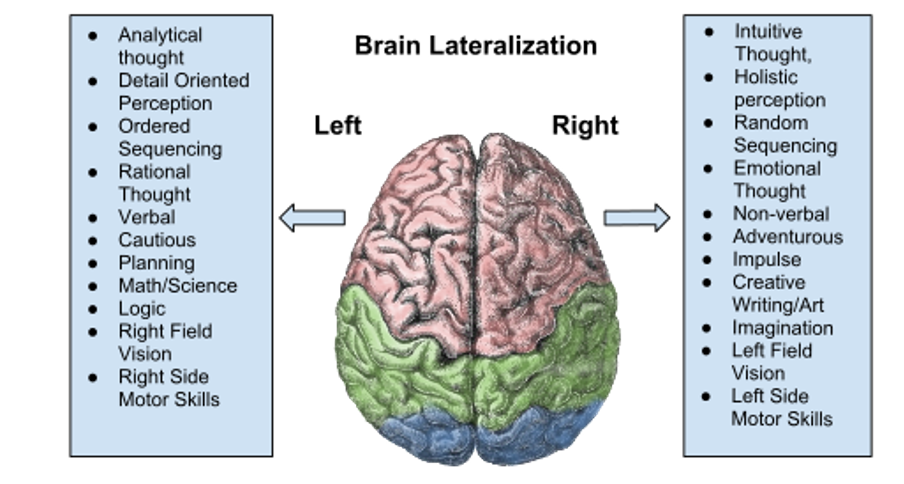
The idea has persisted, but not without much skepticism among neuroscientists. After reading McGilchrist’s book, I, for one, am sold on the model of two distinct hemispheres, not quite as shown in the diagram, but close. His goes further and claims that the pattern of historic cultural behaviors has been shaped by whichever hemisphere dominates. In particular, he argues that the present culture of the West is the result of left-brain dominance, whereas the more primal situation for humans is the opposite. The brain and the world interact in a kind of hermeneutic circle. The state of the brain determines what kind of world we see, that is what we pick out to focus our attention and intentions upon. McGilchrist writes
We bring about a world in consciousness that is partly what is given, and partly what we bring, something that comes into being through this particular conjunction and no other. And the key to this is the kind of attention we pay to the world.
The kind of world we perceive, and our subsequent behavior depends on which side is running the show. The left side produces a mechanistic model of the world; the right a holistic one. The left is analytic and utilitarian; the right caring and empathetic. If you have been following my own work, you would see these two sides as representing two paradigms, modernity and a yet-to-be named paradigm of caring. Flourishing, the fulfillment of human potential, can exist only in the latter. I have come to this conclusion, based largely on philosophical and sociological arguments. What I find so remarkable about his book is that it lays a solid foundation for the existence of these two contrasting worlds in the brain and its two different patterns of perception and response. McGilchrist argues that the right side is the Master in the sense that caring is the more fundamental human disposition to the world but has become over-matched by the left. We need both to survive and evolve culturally as the left allows us to construct the institutional/technological world we have come to inhabit.
The right captures the present moment in its context-rich fullness. It feeds the left as experiences become familiar through repetition. It is the site of the present, the new. McGilchrist lists the following as attributes of the world it creates—presenting, new, whole, integrating, contextual, focused on particular things/individuals, personal, living, and contemporaneous. He finds that his model parallels Heidegger’s sense of Being. Heidegger speaks about “presencing” as a verb, that is, bringing the whole immediate world into consciousness. I find this quite the same as the author’s use of “presenting” as in the idea of the right side displaying a picture of the immediate world with all of its context and integrity to an imaginary actor sitting in the skull.
The left “re-presents” old facts that have been abstracted from experience and generalized. It is like a scientist who breaks down phenomena into small life-less pieces, each with its own set of features. The left cannot make sense out of incoming sensory inputs except by some sort of comparison with whatever is already known and resides there. The list of its attributes includes re-presenting the known, focused on the separate parts, generalizing based on categories, impersonal, non-living and timeless. The left-hemisphere-dominated human is the familiar Homo sapiens or Homo economicus or Homo faber, all names given to our species by various scholars. The right-hemisphere-dominated human sees and behaves so differently that it might justify giving it a distinct species name, Homo amans, coined by Humberto Maturana, to describe the distinctive loving, caring, connected stance. I have started to use the term Homo curitans.
While McGilchrist’s oeuvre serves as a rich source of understanding as to why modern humans are the way they are, the key point for me is his argument that the balance has shifted over time from right to left. I find no mention of any genetic cause for the choice of dominant hemisphere. If we can go from right to left, I see no fundamental obstacle to reversing the balance. As messy as the world of today has become, I can remain hopeful that we can work our way back to a right-hemisphere world of care and context, and via that, the possibility of flourishing.